

Campaign Title:
“Leadership in Crisis: A Budget 2026 Call to Lighten the Load for Primary School Principals”
Overview
The National Principals’ Forum (NPF) calls on the Government of Ireland to urgently address the unsustainable conditions facing primary school principals. Based on the 2025 Principal Workload Survey (with over 400 respondents), it is clear that the role of school leadership is collapsing under the weight of unchecked responsibility, inadequate support, and unfulfilled policy promises.
Budget 2026 must be a turning point. Without decisive structural reform and resourcing, the profession will face mass attrition—threatening the stability of Ireland’s entire primary education system.
Key Issues
1. Unsustainable Workload
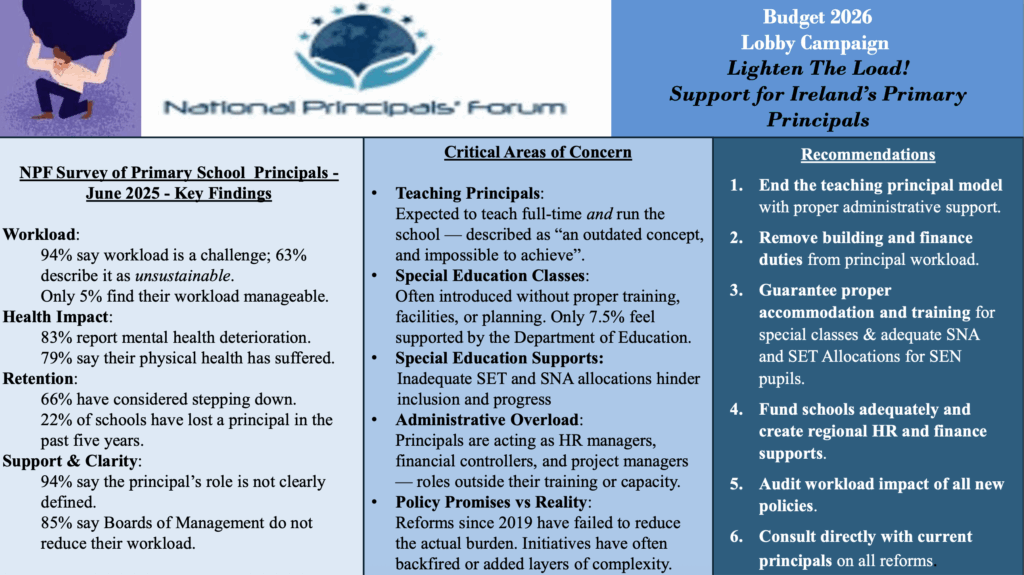
- 94% say workload is a challenge; 63% say it is unsustainable
- Only 5% describe their workload as manageable
- 66% have considered stepping down
2. Health Crisis Among Principals
- 83% report mental health deterioration
- 79% report physical health impacts
- Burnout, anxiety, and stress are common and normalised
3. Collapsing Recruitment and Retention
- 22% of schools have lost a principal in the past 5 years
- Deputy principals increasingly reluctant to step up
- Aspiring leaders deterred by the reality of the role
4. Failure of Special Education Policy Implementation
- Only 16.7% feel trained to lead special classes
- Just 7.5% feel supported by the Department of Education
- Poor accommodation and absence of planning support is rampant
5. Systemic Overload
- Principals serve as de facto HR managers, project managers, and financial controllers without training or staff
- 94% say the role is not clearly defined
- 85% say their Board of Management does not reduce their workload
Budget 2026 Demands
1. End the Teaching Principal Model
⬛➜ Transition to full-time administrative leadership in all schools.
2. Reassign Infrastructure & Capital Works
⬛➜ Establish a National Schools Project Unit to manage building projects.
3. Professionalise School Finance Management
➜⬛ Finance school adequately in the first instance – our capitation and ancillary service grants are paltry in relation to the actual running costs of our schools. We need a dedicated grant to pay for school insurance alone each year. Our minor works and ICT grants must be guaranteed each year, and a set schedule of grant payments communicated to schools in advance of the school year so that we can budget realistically.
➜⬛ Fund qualified financial officers shared across school clusters.
4. Guarantee Infrastructure Before Special Class Approvals
➜⬛ Require verified accommodation and supports prior to opening any new class.
5. Fund Mandatory Training and In-Person Support for Special Education
⬛➜ Reinforce NCSE supports and ensure funded, ongoing training for principals and SNAs.
6. Centralise and Regionalise HR Functions
➜⬛ Establish cluster-based HR support for recruitment, vetting, and contract management.
7. Enforce Workload Impact Reviews for All New Policies
➜⬛ Introduce a burden-analysis mechanism before new circulars or initiatives are issued.
8. Direct Principal Involvement in Policy Development
⬛➜ Make principal consultation mandatory for all decisions impacting school leadership.
Key Messages for Media & Policymakers
- “We’re not leading schools anymore. We’re managing chaos.”
- “Every support promised has added more layers instead of lifting them.”
- “Budget 2026 must invest in school leadership—or risk losing it entirely.”
Conclusion
The data is unambiguous: principalship in Irish primary schools is not merely difficult—it is unsustainable. Budget 2026 must provide the resources, structures, and relief to retain experienced leaders and attract future ones. Irish primary school principals are overburdened, under-supported, and rapidly approaching breaking point. The system needs structural reform
— not more policy — to sustain leadership and ensure school wellbeing.
This is not about sympathy. It is about survival.
The system cannot function if its leaders walk away.